



疑惑
这个文件%s/global/pg_control
什么时候更新呢?它更新会有原子的保证吗?这个我们想过吗
网上找的说明文档
pg_control是一个8KB大小的二进制文件,该文件中记录了PostgreSQL服务器内部信息状态的各方面信息,比如最新检查点(checkpoint)、系统状态、当前运行的postgres服务版本、CRC校验,以及initdb初始化PostgreSQL数据库蔟时设置的某些基本参数。它是在PostgreSQL的7.1版本中新引入的。实际上,该文件中的有效字段值内容仅有几百字节,即sizeof(ControlFileData)
更新源代码
/*
 * update_controlfile()
 *
 * Update controlfile values with the contents given by caller.  The
 * contents to write are included in "ControlFile". "do_sync" can be
 * optionally used to flush the updated control file.  Note that it is up
 * to the caller to properly lock ControlFileLock when calling this
 * routine in the backend.
 */
void
update_controlfile(const char *DataDir,
                   ControlFileData *ControlFile, bool do_sync)
{
    int            fd;
    char        buffer[PG_CONTROL_FILE_SIZE];
    char        ControlFilePath[MAXPGPATH];

    /*
     * Apply the same static assertions as in backend's WriteControlFile().
     */
    StaticAssertStmt(sizeof(ControlFileData) <= PG_CONTROL_MAX_SAFE_SIZE,
                     "pg_control is too large for atomic disk writes");
    StaticAssertStmt(sizeof(ControlFileData) <= PG_CONTROL_FILE_SIZE,
                     "sizeof(ControlFileData) exceeds PG_CONTROL_FILE_SIZE");

    /* Recalculate CRC of control file */
    INIT_CRC32C(ControlFile->crc);
    COMP_CRC32C(ControlFile->crc,
                (char *) ControlFile,
                offsetof(ControlFileData, crc));
    FIN_CRC32C(ControlFile->crc);

    /*
     * Write out PG_CONTROL_FILE_SIZE bytes into pg_control by zero-padding
     * the excess over sizeof(ControlFileData), to avoid premature EOF related
     * errors when reading it.
     */
    memset(buffer, 0, PG_CONTROL_FILE_SIZE);
    memcpy(buffer, ControlFile, sizeof(ControlFileData));

    snprintf(ControlFilePath, sizeof(ControlFilePath), "%s/%s", DataDir, XLOG_CONTROL_FILE);

#ifndef FRONTEND

    /*
     * All errors issue a PANIC, so no need to use OpenTransientFile() and to
     * worry about file descriptor leaks.
     */
    if ((fd = BasicOpenFile(ControlFilePath, O_RDWR | PG_BINARY)) < 0)
        ereport(PANIC,
                (errcode_for_file_access(),
                 errmsg("could not open file \"%s\": %m",
                        ControlFilePath)));
#else
    if ((fd = open(ControlFilePath, O_WRONLY | PG_BINARY,
                   pg_file_create_mode)) == -1)
    {
        pg_log_fatal("could not open file \"%s\": %m", ControlFilePath);
        exit(EXIT_FAILURE);
    }
#endif

    errno = 0;
#ifndef FRONTEND
    pgstat_report_wait_start(WAIT_EVENT_CONTROL_FILE_WRITE_UPDATE);
#endif
    if (write(fd, buffer, PG_CONTROL_FILE_SIZE) != PG_CONTROL_FILE_SIZE)
    {
        /* if write didn't set errno, assume problem is no disk space */
        if (errno == 0)
            errno = ENOSPC;

#ifndef FRONTEND
        ereport(PANIC,
                (errcode_for_file_access(),
                 errmsg("could not write file \"%s\": %m",
                        ControlFilePath)));
#else
        pg_log_fatal("could not write file \"%s\": %m", ControlFilePath);
        exit(EXIT_FAILURE);
#endif
    }
#ifndef FRONTEND
    pgstat_report_wait_end();
#endif

    if (do_sync)
    {
#ifndef FRONTEND
        pgstat_report_wait_start(WAIT_EVENT_CONTROL_FILE_SYNC_UPDATE);
        if (pg_fsync(fd) != 0)
            ereport(PANIC,
                    (errcode_for_file_access(),
                     errmsg("could not fsync file \"%s\": %m",
                            ControlFilePath)));
        pgstat_report_wait_end();
#else
        if (fsync(fd) != 0)
        {
            pg_log_fatal("could not fsync file \"%s\": %m", ControlFilePath);
            exit(EXIT_FAILURE);
        }
#endif
    }

    if (close(fd) != 0)
    {
#ifndef FRONTEND
        ereport(PANIC,
                (errcode_for_file_access(),
                 errmsg("could not close file \"%s\": %m",
                        ControlFilePath)));
#else
        pg_log_fatal("could not close file \"%s\": %m", ControlFilePath);
        exit(EXIT_FAILURE);
#endif
    }
}
调用函数截图
重点关注第一个,其它的几个全是手动去更新,这个频率少
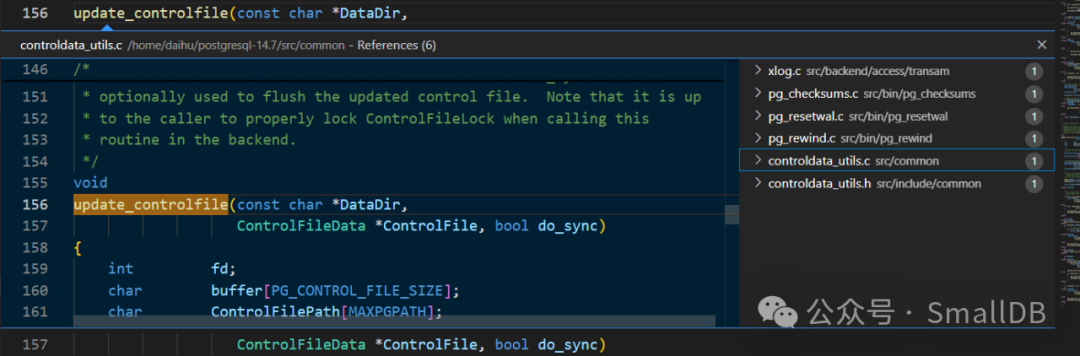
xlog 源代码只关注update_controlfile调用情况
src/backend/access/transam/xlog.c
14处之多调用地方
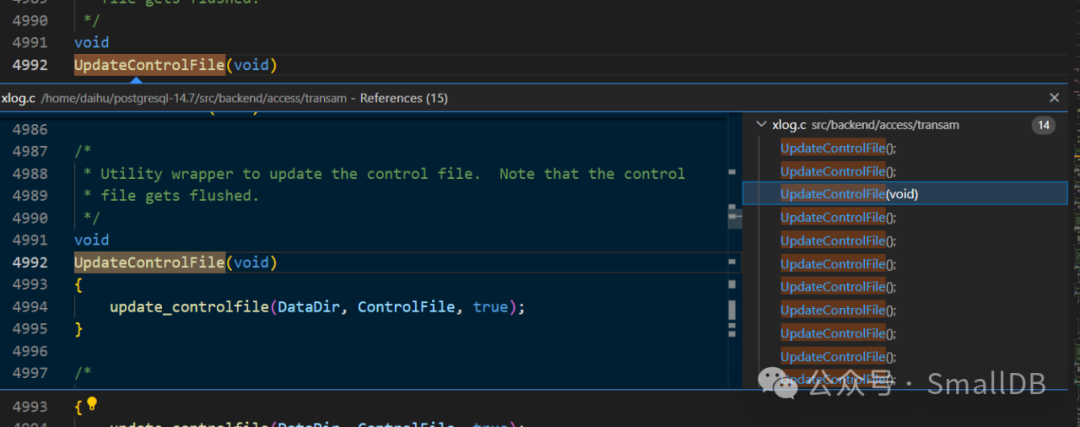
调用函数
static void
UpdateMinRecoveryPoint(XLogRecPtr lsn, bool force)

static XLogRecord *
ReadRecord(XLogReaderState *xlogreader, int emode,
           bool fetching_ckpt)

staticvoid
CheckRecoveryConsistency(void)

void
CreateCheckPoint(int flags)

CreateEndOfRecoveryRecord(void)


staticvoid
CreateEndOfRecoveryRecord(void)
{

bool
CreateRestartPoint(int flags)


staticvoid
XLogReportParameters(void)


xlog_redo(XLogReaderState *record)
总结
pg_control 在如下大部分在如下四种情况下会更新里面的信息
Checkpoint Processing
Database Recovery
Point-in-Time Recovery
Base Backup
文章转载自SmallDB,如果涉嫌侵权,请发送邮件至:contact@modb.pro进行举报,并提供相关证据,一经查实,墨天轮将立刻删除相关内容。
