TAG 6
作者
digoal
日期
2017-01-12
标签
PostgreSQL , psql , 安全 , 密码 , 日志 , password
背景
密码有多重要就不需要多说了,但是你知道密码有多少可能泄露的渠道吗?
大多数人可能觉得在设置好密码后,保管好不被泄露就可以了。
但是你有没有想过,在设置密码的过程中就泄露了呢?
比如数据库中设置用户密码,有多少种可能泄露的渠道?
比如,我们在修改数据库用户密码时,可能经历这么长的流程才能最终将新的密码写入数据库的元数据pg_authid中.
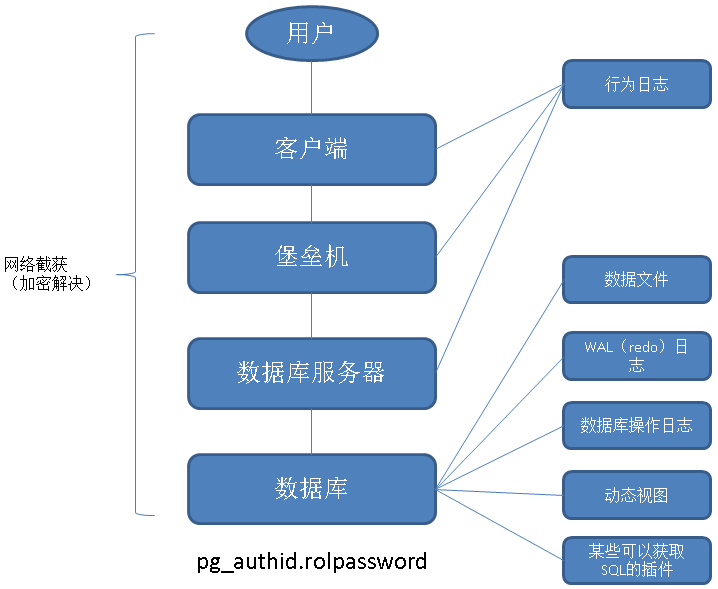
这么多环节,都有可能被不法分子有机可乘。是不是不能简单的认为设置好密码之后就万事大吉了呢?很有可能在你设置的过程中就被截获了。
即使MD5被截获或者泄露,也是危险的,详见
当然,现在PostgreSQL已经意识到这个问题,在进行协议层认证方面的改造,如下:
《元旦技术大礼包 - 2017金秋将要发布的PostgreSQL 10.0已装备了哪些核武器?》
所以为了你的安全,我建议你仔细阅读以下数据库的安全加固方法
《DBA专供 冈本003系列 - 数据库安全第一,过个好年》
本文主要介绍以下psql这个客户端做的一个改进,在设置密码时,隐藏掉明文。(但是你要知道,即使这样,也是不够安全的,安全都是相对的)
psql \password
psql 新增的一个指令如下
\password [USERNAME] securely change the password for a user
对应的源码如下,会将用户输入的文本通过PQencryptPassword函数转换为md5,然后调用PSQLexec执行该ALTER USER XX PASSWORD 'MD5XX';
src/bin/psql/command.c
```
/ \password -- set user password /
else if (strcmp(cmd, "password") == 0)
{
char pw1;
char pw2;
            pw1 = simple_prompt("Enter new password: ", 100, false);
            pw2 = simple_prompt("Enter it again: ", 100, false);

            if (strcmp(pw1, pw2) != 0)
            {
                    psql_error("Passwords didn't match.\n");
                    success = false;
            }
            else
            {
                    char       *opt0 = psql_scan_slash_option(scan_state, OT_SQLID, NULL, true);
                    char       *user;
                    char       *encrypted_password;

                    if (opt0)
                            user = opt0;
                    else
                            user = PQuser(pset.db);

                    encrypted_password = PQencryptPassword(pw1, user);

                    if (!encrypted_password)
                    {
                            psql_error("Password encryption failed.\n");
                            success = false;
                    }
                    else
                    {
                            PQExpBufferData buf;
                            PGresult   *res;

                            initPQExpBuffer(&buf);
                            printfPQExpBuffer(&buf, "ALTER USER %s PASSWORD ",
                                                              fmtId(user));
                            appendStringLiteralConn(&buf, encrypted_password, pset.db);
                            res = PSQLexec(buf.data);
                            termPQExpBuffer(&buf);
                            if (!res)
                                    success = false;
                            else
                                    PQclear(res);
                            PQfreemem(encrypted_password);
                    }

                    if (opt0)
                            free(opt0);
            }
            free(pw2);
    }
```
src/bin/psql/common.c
```
/
* PSQLexec
* This is the way to send "backdoor" queries (those not directly entered
* by the user). It is subject to -E but not -e.
* Caller is responsible for handling the ensuing processing if a COPY
* command is sent.
* Note: we don't bother to check PQclientEncoding; it is assumed that no
* caller uses this path to issue "SET CLIENT_ENCODING".
/
PGresult
PSQLexec(const char query)
{
PGresult res;
    if (!pset.db)
    {
            psql_error("You are currently not connected to a database.\n");
            return NULL;
    }

    if (pset.echo_hidden != PSQL_ECHO_HIDDEN_OFF)
    {
            printf(_("********* QUERY **********\n"
                             "%s\n"
                             "**************************\n\n"), query);
            fflush(stdout);
            if (pset.logfile)
            {
                    fprintf(pset.logfile,
                                    _("********* QUERY **********\n"
                                      "%s\n"
                                      "**************************\n\n"), query);
                    fflush(pset.logfile);
            }

            if (pset.echo_hidden == PSQL_ECHO_HIDDEN_NOEXEC)
                    return NULL;
    }

    SetCancelConn();

    res = PQexec(pset.db, query);

    ResetCancelConn();

    if (!AcceptResult(res))
    {
            ClearOrSaveResult(res);
            res = NULL;
    }

    return res;
}
```
测试
为什么说它不是绝对安全呢?因为MD5本身就不安全,另外同样会有诸多渠道可能泄露这个MD5。
不过任何数据库都一样,没有绝对的安全,都是相对的安全,所以非常建议大伙参考一下文章末尾的几篇文章来加固你的数据库。
```
postgres=# set log_statement='all';
postgres=# set client_min_messages ='log';
postgres=# \password digoal
Enter new password:
Enter it again:
LOG: statement: ALTER USER digoal PASSWORD 'md5462f71c79368ccf422f8a773ef40074d'
postgres=# select * from pg_authid where rolname='digoal';
LOG: statement: select * from pg_authid where rolname='digoal';
rolname | rolsuper | rolinherit | rolcreaterole | rolcreatedb | rolcanlogin | rolreplication | rolbypassrls | rolconnlimit | rolpassword | rolvaliduntil
---------+----------+------------+---------------+-------------+-------------+----------------+--------------+--------------+-------------------------------------+---------------
digoal | f | t | f | f | t | f | f | -1 | md5462f71c79368ccf422f8a773ef40074d |
(1 row)
```
源码层思考
从源码层面如何杜绝单一的加密方法呢?
比如引入可以识别instance的UUID,例如systemid,多重加密,这样的话可能破解难度会进一步加大,或者避免一些重复的密码问题。
参考
《元旦技术大礼包 - 2017金秋将要发布的PostgreSQL 10.0已装备了哪些核武器?》
《DBA专供 冈本003系列 - 数据库安全第一,过个好年》
PostgreSQL 许愿链接
您的愿望将传达给PG kernel hacker、数据库厂商等, 帮助提高数据库产品质量和功能, 说不定下一个PG版本就有您提出的功能点. 针对非常好的提议,奖励限量版PG文化衫、纪念品、贴纸、PG热门书籍等,奖品丰富,快来许愿。开不开森.
9.9元购买3个月阿里云RDS PostgreSQL实例
PostgreSQL 解决方案集合
德哥 / digoal's github - 公益是一辈子的事.