



Selective Data Acquisition in the Wild for Model Charging.pdf
免费下载
Selective Data Acquisition in the Wild for Model Charging
Chengliang Chai
Tsinghua University
Beijing, China
ccl@mail.tsinghua.edu.cn
Jiabin Liu
Tsinghua University
Beijing, China
liujb19@mails.tsinghua.edu.cn
Nan Tang
QCRI
Doha, Qatar
ntang@hbku.edu.qa
Guoliang Li
Tsinghua University
Beijing, China
liguoliang@tsinghua.edu.cn
Yuyu Luo
Tsinghua University
Beijing, China
luoyy18@mails.tsinghua.edu.cn
ABSTRACT
The lack of sucient labeled data is a key bottleneck for practition-
ers in many real-world supervised machine learning (ML) tasks. In
this paper, we study a new problem, namely selective data acquisi-
tion in the wild for model charging: given a supervised ML task and
data in the wild (e.g., enterprise data warehouses, online data repos-
itories, data markets, and so on), the problem is to select labeled
data points from the data in the wild as additional train data that
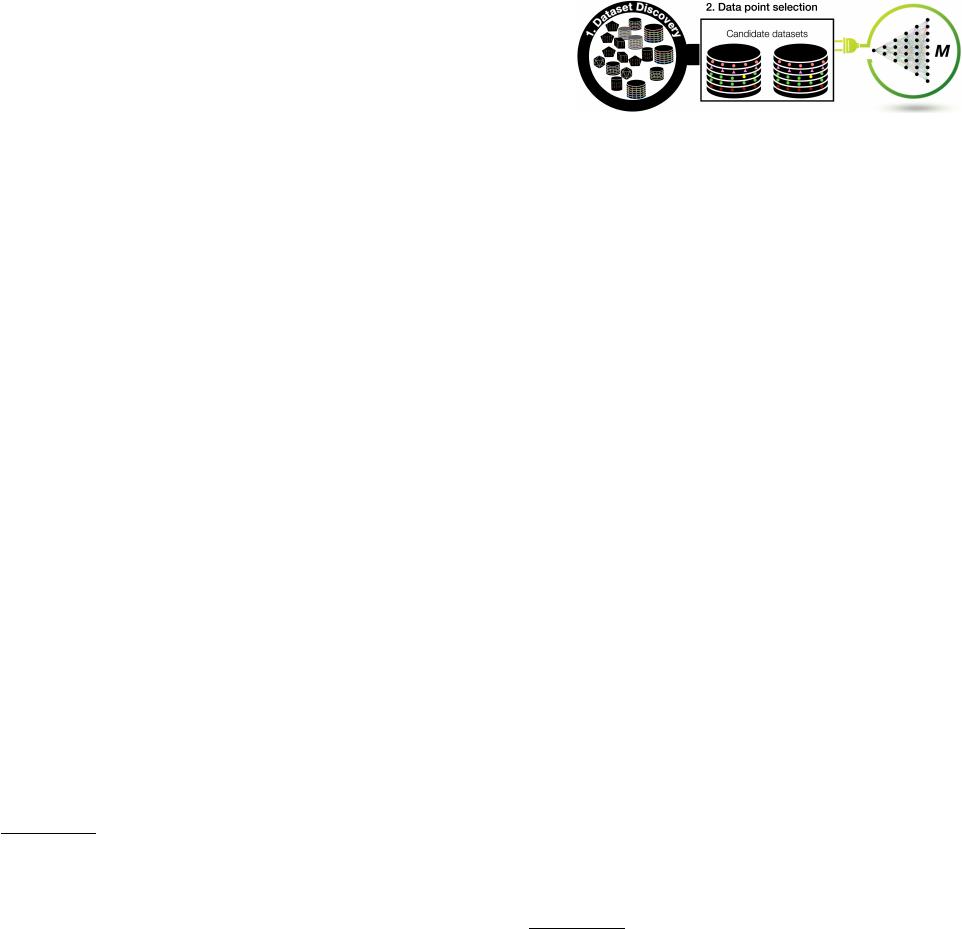
can help the ML task. It consists of two steps (Fig. 1). The rst step
is to discover relevant datasets (e.g., tables with similar relational
schema), which will result in a set of candidate datasets. Because
these candidate datasets come from dierent sources and may fol-
low dierent distributions, not all data points they contain can help.
The second step is to select which data points from these candidate
datasets should be used. We build an end-to-end solution. For step
1, we piggyback o-the-shelf data discovery tools. Technically, our
focus is on step 2, for which we propose a solution framework called
AutoData
. It rst clusters all data points from candidate datasets
such that each cluster contains similar data points from dierent
sources. It then iteratively picks which cluster to use, samples data
points (i.e., a mini-batch) from the picked cluster, evaluates the
mini-batch, and then revises the search criteria by learning from
the feedback (i.e., reward) based on the evaluation. We propose a
multi-armed bandit based solution and a Deep Q Networks-based
reinforcement learning solution. Experiments using both relational
and image datasets show the eectiveness of our solutions.
PVLDB Reference Format:
Chengliang Chai, Jiabin Liu, Nan Tang, Guoliang Li, and Yuyu Luo.
Selective Data Acquisition in the Wild for Model Charging. PVLDB, 15(7):
1466-1478, 2022.
doi:10.14778/3523210.3523223
1 INTRODUCTION
Data-centric ML. In many supervised ML projects, the main bot-
tleneck is the lack of sucient labeled train data (a.k.a. data-centric
This work is licensed under the Creative Commons BY-NC-ND 4.0 International
License. Visit https://creativecommons.org/licenses/by-nc-nd/4.0/ to view a copy of
this license. For any use beyond those covered by this license, obtain permission by
emailing info@vldb.org. Copyright is held by the owner/author(s). Publication rights
licensed to the VLDB Endowment.
Proceedings of the VLDB Endowment, Vol. 15, No. 7 ISSN 2150-8097.
doi:10.14778/3523210.3523223
Figure 1: Selective data acquisition for model charging.
ML) [
9
,
28
,
36
,
37
], not which ML models to use and how to op-
timize these models (a.k.a. model-centric ML), especially for ML
practitioners.
Example 1.
[
Insucient train data.
]
Consider Fig. 2(a) that shows
a dataset
𝑇
train
, which is used to train a regression model to predict
the house
Price
at Kolkata, India, based on the features (
City
,
Year
,
Area
,
Security
). The test data
𝑇
test
is given in Fig. 2(b), whose
Price
values are to be predicted. The ground truth
Price
values are
also provided for helping the discussion.
Figure 3(a) shows both the learned model using only
𝑇
train
(i.e.,
Line 1) and the ground truth model that we want to learn (i.e., Line 2).
Because
𝑇
train
is small and does not contain sucient data points
(e.g., there are many houses with
Area >
1000 or
<
700 in
𝑇
test
, but
all houses in
𝑇
train
have
Area
in the range
[
700
,
1000
]
), the mo del
trained using 𝑇
train
(i.e., Line 1) is not good enough for 𝑇
test
.
Data acquisition. The process of getting more labeled data is
known as data acquisition, which is categorized into two classes:
human-in-the-loop and automatic data acquisition. Human-in-the-
loop data acquisition includes weak supervision where users need to
dene rules (e.g., Snorkel [
43
], data programming [
42
]), and crowd-
and expert-sourcing. Automatic data acquisition uses automatic
methods to obtain more train data.
Selective data acquisition in the wild for model charging. We
ask whether it is possible to nd useful data points from the data in
the wild as shown in Fig. 1 so as to “charge” the model, where we
know that dierent datasets may follow dierent data distributions,
but meanwhile, we also hypothesize that some data points can help.
For doing so, the rst step is to select candidate datasets. For
tables, this is known as data discovery with many o-the-shelf
The rst two authors contributed equally to this research. Guoliang Li is the corre-
sponding author.
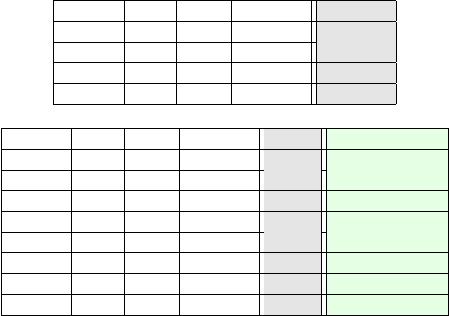
City Year Area Security Price
Kolkata 2009 710 No 3,200,000
Kolkata 2013 770 No 3,850,000
Kolkata 2007 935 No 2,524,000
Kolkata 2006 973 Yes 3,611,000
(a) 𝑇
train
: Train dataset (learn to predict “Price”).
City Year Area Security Price Ground Truth
Kolkata 2017 350 No ? 2,100,000
Kolkata 2019 465 Yes ? 4,365,000
Kolkata 2015 572 No ? 3,268,000
Kolkata 2012 655 Yes ? 2,599,000
Kolkata 2012 735 No ? 3,300,000
Kolkata 2017 881 Yes ? 4,698,000
Kolkata 2011 1123 Yes ? 3,324,000
Kolkata 2014 1210 Yes ? 5,000,000
(b) 𝑇
test
: Test dataset (predict the “Price” column).
Figure 2: Sample train and test datasets.
tools [
11
,
16
,
34
]. For images, there are many benchmarks, as well
as Web APIs such as Google, Baidu or Azure image search.
Example 2.
[
Using all data points in candidate datasets.
]
Fig. 3(b)(c) and (d) show three datasets that also contain house price
information in dierent cities of India, i.e.,
𝐷
1
,
𝐷
2
and
𝐷
3
for Ban-
glore, Mumbai, and Delhi, respectively. They have dierent schemata
with 𝑇
train
and 𝑇
test
in Fig. 2, but they can be used as train data.
A straightforward solution is to add all these datasets to the train
data (i.e.,
𝑇
train
:
= 𝑇
train
∪ 𝐷
1
∪ 𝐷
2
∪ 𝐷
3
) and train a model. By
doing so, we can obtain a model as shown in Fig. 3(a) Line 3, which,
unfortunately, deviates far from the ground truth model Line 2.
Our question is that: given candidate datasets, whether selecting
some data points will be better than using all?
Example 3.
[
Selected data points.
]
If we can select “good” data
points, such as
{𝑟
1
}
from
𝐷
1
,
{𝑠
1
, 𝑠
2
, 𝑠
3
}
from
𝐷
2
, and
{𝑡
1
, 𝑡
4
}
from
𝐷
3
as additional train data that are highlighted in Figs. 3(b–d), we
can use them in Fig. 3(a) (i.e., those annotated by green frames) and
train a model Line 4. Clearly, Line 4 is much closer, thus better than
Line 1 and Line 3, to the ground truth model Line 2.
Example 1 shows that more labeled data is needed. Example 2
tells us using all data points is not ideal. Example 3 shows it is more
benecial to select some data points.
Challenges. There are two essential challenges. First, candidate
datasets may come from various data distributions that are dierent
from the desired data distribution of the ML task, which is unknown.
Second, many data points in these candidate sets are not good w.r.t.
our ML task, which raises the challenge that how can we eectively
select and measure which new data points should be added.
Contributions. Our contributions are summarized as follows.
(1) Selective data acquisition in the wild for model charging.
We study the problem of automatic data acquisition for supervised
ML in a new setting where the supervised ML task does not have
enough train data, and it has access to the data in the wild (Section 2).
Note that datasets in the wild are heterogeneous and not all of data
points can help the task.
(2) A solution framework. We propose a solution framework (see
Fig. 1) that consists of two steps: dataset discovery that selects
candidate datasets and data points selection that selects data
points from these candidate datasets. (Section 3)
(3)
AutoData
with multi-arme d bandit. We introduce a classi-
cal multi-armed bandit based solution to handle the exploration-
exploitation trade-o for AutoData. (Section 4)
(4)
AutoData
with Deep Q Network-based reinforcement learn-
ing (RL). Another eective model is to use Deep Q learning based
RL, which learns a neural network to approximate the Q-table (i.e., a
simple but huge lookup table that calculates the maximum expected
future rewards for action at each state) that decides which cluster
to select based on the current status. (Section 5)
(5) Evaluation. We conduct extensive experiment to show that
our methods can eectively select data points from dierent data
sources and improve the ML performance by maximum 14.8% and
8.3% on relational and image datasets, respectively. (Section 6)
2 PRELIMINARY
Supervise d machine learning. We consider supervised ML as
training a model
𝑀
to learn a function
𝑓 ()
that maps an input to
an output based on example input-output pairs as 𝑓 : X → Y.
We use
𝑀 (𝐴)
to denote the model
𝑀
that is trained with dataset
𝐴
, and the notation
𝑀 (𝐴, 𝐵)
to denote the model
𝑀
that is trained
with 𝐴 and is evaluated with dataset 𝐵.
Train/validation/test datasets. A set of labeled dataset
𝑇
is
typically split into three disjoint subsets as train/validation/test
(𝑇
train
/𝑇
val
/𝑇
test
). 𝑇
test
is completely held-out during training.
Data in the wild. We use the term data in the wild to generally
refer to all datasets that one can have access to, including data lakes,
data markets, online data repositories, enterprise data warehouses,
and so on. More specically, for supervised ML, we consider it as a
set of datasets
D = {𝐷
1
, . . . , 𝐷
𝑚
}
, where
𝐷
𝑖
(
𝑖 ∈ [
1
,𝑚]
) is a set of
(data point, label) pairs.
Candidate datasets. The candidate datasets w.r.t. a supervised ML
task
𝑀
, denoted by
D
𝑐
, is a subset of
D
that contains datasets
“relevant” to
𝑀
. For tabular data, the relevance typically means that
these candidate datasets have the same or highly overlapping rela-
tional schema with
𝑇
train
. For image data, the relevance typically
means that these candidate datasets contain images that have the
same labels (e.g., {cat, dog, bird, sh}) as 𝑇
train
.
Candidate data pool. The candidate data pool (or simply data
pool), denoted by
P
, is the union of all data points in the candidate
datasets, i.e., P =
Ð
(𝑥,𝑦) ∈𝐷
𝑖
,𝐷
𝑖
∈D
𝑐
(𝑥, 𝑦).
Selective data acquisition for model charging. Given a super-
vised ML task with a pre-specied model
𝑀
, train/validation/test
datasets (
𝑇
train
/
𝑇
val
/
𝑇
test
), and a candidate data pool
P
, the prob-
lem is to select a subset
P
∗
⊂ P
using
𝑇
train
and
𝑇
val
, such that
it can obtain the most performance improvement of the super-
vised ML task on
𝑇
test
:
P
∗
= arg max
P
′
⊂ P
𝑀 (𝑇
train
∪P
′
,𝑇
test
) −
𝑀 (𝑇
train
,𝑇
test
).
Example 4.
[
Selective data acquisition.
]
Given an ML task of
training a regression model using
𝑇
train
as shown in Fig. 2 and a data
of 13
免费下载
【版权声明】本文为墨天轮用户原创内容,转载时必须标注文档的来源(墨天轮),文档链接,文档作者等基本信息,否则作者和墨天轮有权追究责任。如果您发现墨天轮中有涉嫌抄袭或者侵权的内容,欢迎发送邮件至:contact@modb.pro进行举报,并提供相关证据,一经查实,墨天轮将立刻删除相关内容。
下载排行榜

评论