



A刊-Fluid-Shuttle_Efficient_Cloud_Data_Transmission_Based_on_Serverless_Computing_CompressionFluid-Shuttle.pdf
免费下载

IEEE/ACM TRANSACTIONS ON NETWORKING 1
Fluid-Shuttle: Efficient Cloud Data Transmission
Based on Serverless Computing Compression
Rong Gu , Member, IEEE, Shulin Wang, Haipeng Dai , Senior Member, IEEE, Xiaofei Chen,
Zhaokang Wang , Wenjie Bao, Jiaqi Zheng , Senior Member, IEEE, Yaofeng Tu, Yihua Huang ,
Lianyong Qi , Senior Member, IEEE, Xiaolong Xu , Senior Member, IEEE,
Wanchun Dou , and Guihai Chen , Fellow, IEEE
Abstract— Nowadays, there exists a lot of cross-region data
transmission demand on the cloud. It is promising to use
serverless computing for data compressing to save the total data
size. However, it is challenging to estimate the data transmission
time and monetary cost with serverless compression. In addition,
minimizing the data transmission cost is non-trivial due to the
enormous parameter space. This paper focuses on this problem
and makes the following contributions: 1) We propose empirical
data transmission time and monetary cost models based on
serverless compression. It can also predict compression infor-
mation, e.g., ratio and speed using chunk sampling and machine
learning techniques. 2) For single-task cloud data transmission,
we propose two efficient parameter search methods based on
Sequential Quadratic Programming (SQP) and Eliminate then
Divide and Conquer (EDC) with proven error upper bounds.
Besides, we propose a parameter fine-tuning strategy to deal
with transmission bandwidth variance. 3) Furthermore, for multi-
task scenarios, a parameter search method based on dynamic
programming and numerical computation is proposed. We have
implemented the system called Fluid-Shuttle, which includes
straggler optimization, cache optimization, and the autoscaling
decompression mechanism. Finally, we evaluate the performance
of Fluid-Shuttle with various workloads and applications on the
real-world AWS serverless computing platform. Experimental
results show that the proposed approach can improve the param-
eter search efficiency by over 3× compared with the state-of-art
methods and achieves better parameter quality. In addition, our
Manuscript received 25 May 2023; revised 7 February 2024;
accepted 18 April 2024; approved by IEEE/ACM TRANSACTIONS ON
NETWORKING Editor R. Pedarsani. This work was supported in part by
the National Natural Science Foundation of China under Grant 62072230,
Grant 62272223, and Grant U22A2031; in part by Jiangsu Province
Science and Technology Key Program under Grant BE2021729; and in
part by the Collaborative Innovation Center of Novel Software Technology
and Industrialization. (Corresponding authors: Rong Gu; Haipeng Dai;
Jiaqi Zheng.)
Rong Gu, Shulin Wang, Haipeng Dai, Xiaofei Chen, Wenjie Bao,
Jiaqi Zheng, Yihua Huang, Wanchun Dou, and Guihai Chen are
with the State Key Laboratory for Novel Software Technology,
Nanjing University, Nanjing, Jiangsu 210023, China (e-mail:
gurong@nju.edu.cn; wangshulin@smail.nju.edu.cn; haipengdai@nju.edu.cn;
xfchen@smail.nju.edu.cn; bwj_678@qq.com; jzheng@nju.edu.cn; yhuang@
nju.edu.cn; douwc@nju.edu.cn; gchen@nju.edu.cn).
Zhaokang Wang is with the College of Computer Science and Technology,
Nanjing University of Aeronautics and Astronautics, Nanjing 210016, China
(e-mail: wangzhaokang@nuaa.edu.cn).
Yaofeng Tu is with ZTE Corporation, Shenzhen 518057, China (e-mail:
tu.yaofeng@zte.com.cn).
Lianyong Qi is with the College of Computer Science and Technology,
China University of Petroleum (East China), Dongying 257099, China
(e-mail: lianyongqi@gmail.com).
Xiaolong Xu is with the School of Software, Nanjing University of
Information Science and Technology, Nanjing 210044, China (e-mail:
xlxu@nuist.edu.cn).
Digital Object Identifier 10.1109/TNET.2024.3402561
approach achieves higher time efficiency and lower monetary cost
compared with competing cloud data transmission approaches.
Index Terms— Data transmission, serverless compression,
cloud function configuration.
I. INTRODUCTION
N
OWADAYS, a large amount of data needs to be trans-
ferred across data centers or cloud regions [1]. For
example, software/model distribution, database replication,
search index synchronization, and other data backup opera-
tions require frequent data transmission on the cloud [2]. It is
reported that 70% of IT firms have massive data transmission
among data centers, ranging from 330 TB to 3.3 PB per
month, and the amount of data keeps overgrowing [3]. Data
transmission over long distances consumes massive band-
width resources, which is costly on the cloud. Cloud service
providers have spent hundreds of millions of US dollars on
data transmission every year [4]. Therefore, improving time
efficiency and reducing the monetary cost of cross-region
data transmission on the cloud is vital. In order to save the
bandwidth cost and improve data transmission efficiency, data
is usually compressed before transmission [5], [6]. However,
data compression itself brings extra computation costs. Thus,
it is important to make a tradeoff between the compression
computation cost and the saved bandwidth cost.
In the traditional cloud environment, it is common to rent
virtual machines (VMs) for data compression [7]. However,
the VMs are heavy for data transmission tasks because they
usually take nearly 1 minute to start [8] and are charged
hourly. In recent years, serverless computing is emerging
as the next generation of cloud computing technology [9].
It provides computing resources by cloud functions (e.g., AWS
Lambda [10]) with strong elasticity and fine-grained billing.
We compared the data transmission time and monetary cost
of using cloud functions compression with virtual machine
compression to transfer a 1 GB Lineitem dataset [11] on
AWS.
1
Experimental results show that the end-to-end data
transmission time of serverless compression (including cold
start time) is 1/4 of that of virtual machine compression
(including boot-up time).
Nevertheless, achieving efficient data transmission with
serverless compression faces the challenge of choosing
1
We use a typical AWS EC2 c5a.xlarge instance with 4 vCPU and 8 GB
memory, and 4 cloud functions each has 1536 MB memory.
1558-2566 © 2024 IEEE. Personal use is permitted, but republication/redistribution requires IEEE permission.
See https://www.ieee.org/publications/rights/index.html for more information.
This article has been accepted for inclusion in a future issue of this journal. Content is final as presented, with the exception of pagination.
Authorized licensed use limited to: ZTE CORPORATION. Downloaded on November 26,2024 at 05:42:44 UTC from IEEE Xplore. Restrictions apply.
2 IEEE/ACM TRANSACTIONS ON NETWORKING
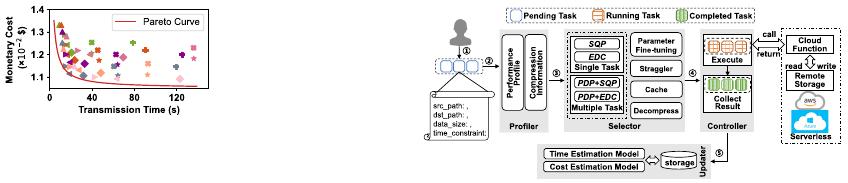
Fig. 1. Transmission time and monetary costs of transferring 1 GB
Lineitem dataset with various configurations. Colors represent cloud function
configurations, and shapes represent compression method types.
appropriate configurations, including the data compression
method type, parameters of serverless cloud functions, etc.
It needs proper configurations to balance the computation cost
and saved bandwidth cost [5], [6]. Fig. 1 shows the data
transmission time and monetary cost of transferring the 1 GB
Lineitem dataset using different AWS Lambda configurations
(the transmission process is shown in Fig. 3). The configu-
rations simultaneously impact the data transmission time and
monetary cost in a non-trivial fashion. For a given time con-
straint, there exist noticeable differences in data transmission
monetary costs among various configurations. We find that the
best configurations can reduce the data transmission monetary
cost by up to 75% compared with the worst ones. Therefore,
finding the optimal configuration is critical to reducing the
time and monetary cost of the data transmission on the cloud.
Existing works have limitations in considering the total
cost or all execution parameters on the cloud. They can be
classified to two categories. One category minimizes the data
transmission time and cost by optimizing system mechanisms
(e.g., the combination of multiple storage tiers [12], [13],
communication method [14]). However, these works do not
consider the expensive bandwidth cost and are not in our
problem scope. The other category searches proper config-
urations [15], [16] to reduce both time and monetary cost of
data transmission by using serverless computing, while these
methods only consider the cloud function memory size.
There are three main challenges in achieving time-efficient
and cost-saving cloud data transmission with serverless com-
pression. First, it is non-trivial to model and estimate the
time and monetary cost of the cloud data transmission with
serverless compression. Second, finding the optimal parame-
ters of the cloud data transmission system is time-consuming
due to enormous parameter space and joint optimization
among parameters. In addition, the non-continuous differ-
entiable objective function and constraint make it difficult
to find algebraic solutions. Third, when multiple cloud data
transmission tasks run concurrently, different tasks compete
for the shared concurrency of cloud functions, leading to
the parameter search space increasing exponentially with the
number of tasks.
To address the above challenges, we model the data trans-
mission process and formulate the parameter search problem
as a mixed-integer non-linear programming problem. For
various input data, we propose to predict the compression
information instead of using empirical settings. Furthermore,
by enumeration, objective function simplification, and convert-
ing non-continuous differentiable, we propose two efficient
and error-bounded optimal parameter search methods SQP
and EDC for single-task data transmission. For multiple-task
data transmission, we use dynamic programming and numeri-
Fig. 2. Overview of Fluid-Shuttle system.
cal analysis to solve the concurrency competition. Specifically,
our main contributions are as follows.
• For cloud data transmission based on serverless com-
pression, we propose two empirical models with high
accuracy to estimate the time cost and the monetary
cost. Besides, we propose a compression information
prediction method based on chunk sampling and machine
learning techniques. Then, we formulate the parameter
search task as a constrained mixed-integer non-linear
programming problem.
• After using enumeration, objective function simpli-
fication, and converting non-continuous differentiable
techniques, we propose two efficient and error-bounded
optimal parameter search methods SQP and EDC for
single-task data transmission. To deal with bandwidth
variance, we model bandwidth using Weibull distribution
and fine-tune the resource setting as necessary.
• To search high-quality configurations for multiple-task
data transmission, we propose a hybrid search method
based on dynamic programming and numerical analysis,
reducing time complexity from exponential to linear.
• Finally, we implement the system called Fluid-Shuttle
with straggler optimization, cache optimization, and
the autoscaling decompression mechanism. Experimental
results on the real-world cloud platform with various
workloads show that the proposed methods improve the
parameter search speed over 3×, compared with the state-
of-the-art methods, and have better parameter quality.
Fluid-Shuttle brings 1.4× performance improvement and
saves 55.8% monetary cost on average when transferring
data across cloud regions, compared with existing solu-
tions.
II. SYSTEM OVERVIEW
The overview architecture of our Fluid-Shuttle system is
shown in Fig. 2. It contains four main modules: Profiler,
Selector, Controller, and Updater. The Profiler module col-
lects the necessary information for data transmission tasks
and predicts compression information for various transmission
data. The Selector module selects a proper parameter search
method according to the target scenario. In addition, we have
packaged some extensions described in the following parts
for users according to their scenarios. The Controller module
calls cloud functions to execute data transmission tasks. It also
monitors related metrics. The Updater module updates the
internal parameters of the time and cost estimation models
based on the collected metrics.
The system workflow runs in steps as follows.
This article has been accepted for inclusion in a future issue of this journal. Content is final as presented, with the exception of pagination.
Authorized licensed use limited to: ZTE CORPORATION. Downloaded on November 26,2024 at 05:42:44 UTC from IEEE Xplore. Restrictions apply.
of 16
免费下载
【版权声明】本文为墨天轮用户原创内容,转载时必须标注文档的来源(墨天轮),文档链接,文档作者等基本信息,否则作者和墨天轮有权追究责任。如果您发现墨天轮中有涉嫌抄袭或者侵权的内容,欢迎发送邮件至:contact@modb.pro进行举报,并提供相关证据,一经查实,墨天轮将立刻删除相关内容。
下载排行榜

文档被以下合辑收录
评论