



Machine Learning Super VIP Cheatsheet.pdf
免费下载

CS 229 – Machine Learning https://stanford.edu/~shervine
Super VIP Cheatsheet: Machine Learning
Afshine Amidi and Shervine Amidi
September 15, 2018
Contents
1 Supervised Learning 2
1.1 Introduction to Supervised Learning . . . . . . . . . . . . . . . . . . . 2
1.2 Notations and general concepts . . . . . . . . . . . . . . . . . . . . . 2
1.3 Linear models . . . . . . . . . . . . . . . . . . . . . . . . . . . . . . 2
1.3.1 Linear regression . . . . . . . . . . . . . . . . . . . . . . . . . 2
1.3.2 Classification and logistic regression . . . . . . . . . . . . . . . 3
1.3.3 Generalized Linear Models . . . . . . . . . . . . . . . . . . . . 3
1.4 Support Vector Machines . . . . . . . . . . . . . . . . . . . . . . . . 3
1.5 Generative Learning . . . . . . . . . . . . . . . . . . . . . . . . . . . 4
1.5.1 Gaussian Discriminant Analysis . . . . . . . . . . . . . . . . . 4
1.5.2 Naive Bayes . . . . . . . . . . . . . . . . . . . . . . . . . . . 4
1.6 Tree-based and ensemble methods . . . . . . . . . . . . . . . . . . . . 4
1.7 Other non-parametric approaches . . . . . . . . . . . . . . . . . . . . 4
1.8 Learning Theory . . . . . . . . . . . . . . . . . . . . . . . . . . . . . 5
2 Unsupervised Learning 6
2.1 Introduction to Unsupervised Learning . . . . . . . . . . . . . . . . . 6
2.2 Clustering . . . . . . . . . . . . . . . . . . . . . . . . . . . . . . . . 6
2.2.1 Expectation-Maximization . . . . . . . . . . . . . . . . . . . . 6
2.2.2 k-means clustering . . . . . . . . . . . . . . . . . . . . . . . . 6
2.2.3 Hierarchical clustering . . . . . . . . . . . . . . . . . . . . . . 6
2.2.4 Clustering assessment metrics . . . . . . . . . . . . . . . . . . 6
2.3 Dimension reduction . . . . . . . . . . . . . . . . . . . . . . . . . . . 7
2.3.1 Principal component analysis . . . . . . . . . . . . . . . . . . 7
2.3.2 Independent component analysis . . . . . . . . . . . . . . . . . 7
3 Deep Learning 8
3.1 Neural Networks . . . . . . . . . . . . . . . . . . . . . . . . . . . . . 8
3.2 Convolutional Neural Networks . . . . . . . . . . . . . . . . . . . . . 8
3.3 Recurrent Neural Networks . . . . . . . . . . . . . . . . . . . . . . . 8
3.4 Reinforcement Learning and Control . . . . . . . . . . . . . . . . . . . 9
4 Machine Learning Tips and Tricks 10
4.1 Metrics . . . . . . . . . . . . . . . . . . . . . . . . . . . . . . . . . . 10
4.1.1 Classification . . . . . . . . . . . . . . . . . . . . . . . . . . . 10
4.1.2 Regression . . . . . . . . . . . . . . . . . . . . . . . . . . . . 10
4.2 Model selection . . . . . . . . . . . . . . . . . . . . . . . . . . . . . . 11
4.3 Diagnostics . . . . . . . . . . . . . . . . . . . . . . . . . . . . . . . . 11
5 Refreshers 12
5.1 Probabilities and Statistics . . . . . . . . . . . . . . . . . . . . . . . . 12
5.1.1 Introduction to Probability and Combinatorics . . . . . . . . . 12
5.1.2 Conditional Probability . . . . . . . . . . . . . . . . . . . . . 12
5.1.3 Random Variables . . . . . . . . . . . . . . . . . . . . . . . . 13
5.1.4 Jointly Distributed Random Variables . . . . . . . . . . . . . . 13
5.1.5 Parameter estimation . . . . . . . . . . . . . . . . . . . . . . 14
5.2 Linear Algebra and Calculus . . . . . . . . . . . . . . . . . . . . . . . 14
5.2.1 General notations . . . . . . . . . . . . . . . . . . . . . . . . 14
5.2.2 Matrix operations . . . . . . . . . . . . . . . . . . . . . . . . 15
5.2.3 Matrix properties . . . . . . . . . . . . . . . . . . . . . . . . 15
5.2.4 Matrix calculus . . . . . . . . . . . . . . . . . . . . . . . . . 16
Stanford University 1 Fall 2018
CS 229 – Machine Learning Shervine Amidi & Afshine Amidi
1 Supervised Learning
1.1 Introduction to Supervised Learning
Given a set of data points {x
(1)
, ..., x
(m)
} associated to a set of outcomes {y
(1)
, ..., y
(m)
}, we
want to build a classifier that learns how to predict y from x.
r Type of prediction – The different types of predictive models are summed up in the table
below:
Regression Classifier
Outcome Continuous Class
Examples Linear regression Logistic regression, SVM, Naive Bayes
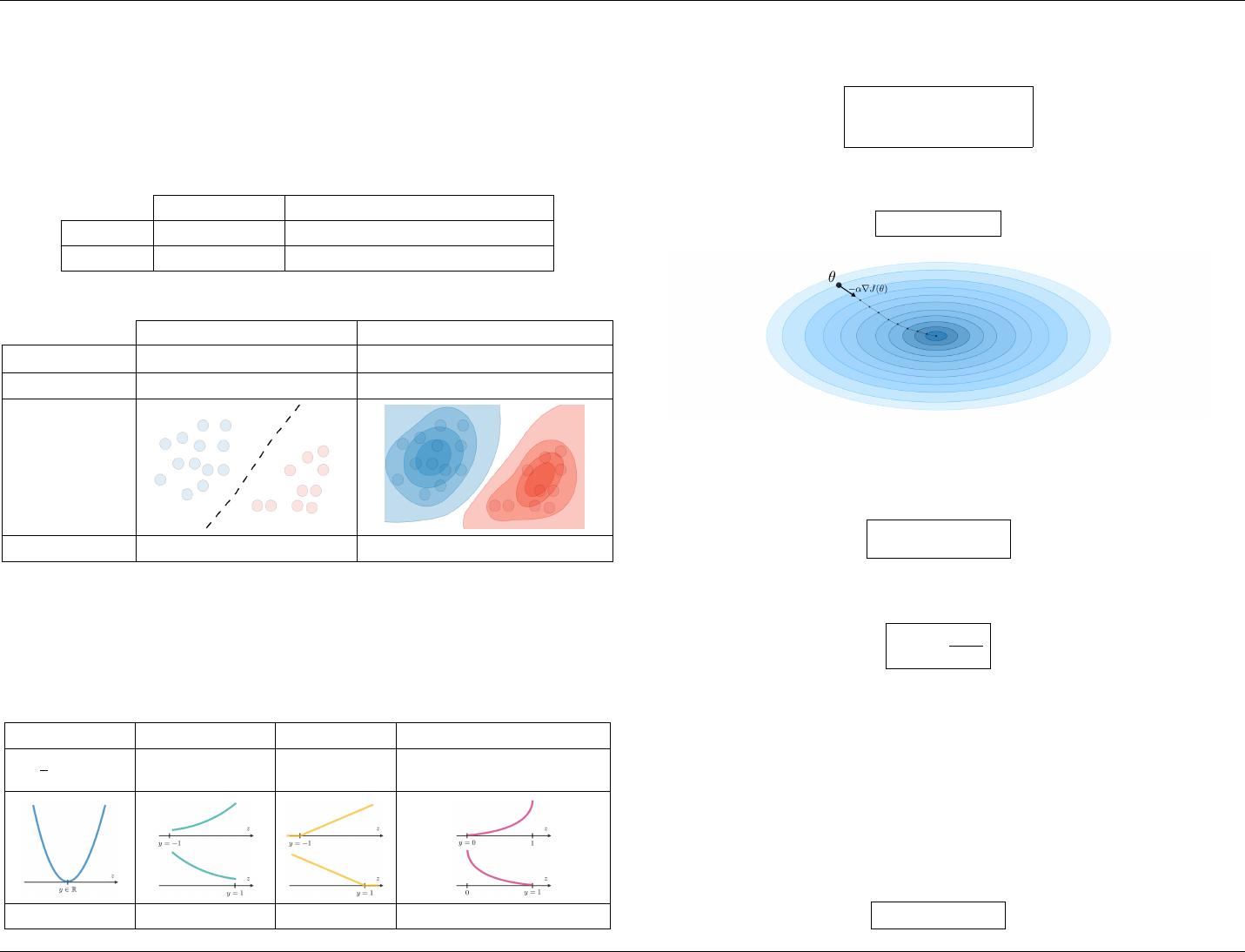
r Type of model – The different models are summed up in the table below:
Discriminative model Generative model
Goal Directly estimate P (y|x) Estimate P (x|y) to deduce P (y|x)
What’s learned Decision boundary Probability distributions of the data
Illustration
Examples Regressions, SVMs GDA, Naive Bayes
1.2 Notations and general concepts
r Hypothesis – The hypothesis is noted h
θ
and is the model that we choose. For a given input
data x
(i)
, the model prediction output is h
θ
(x
(i)
).
r Loss function – A loss function is a function L : (z,y) ∈ R × Y 7−→ L(z,y) ∈ R that takes as
inputs the predicted value z corresponding to the real data value y and outputs how different
they are. The common loss functions are summed up in the table below:
Least squared Logistic Hinge Cross-entropy
1
2
(y − z)
2
log(1 + exp(−yz)) max(0,1 − yz) −
y log(z) + (1 − y) log(1 − z)
Linear regression Logistic regression SVM Neural Network
r Cost function – The cost function J is commonly used to assess the performance of a model,
and is defined with the loss function L as follows:
J(θ) =
m
X
i=1
L(h
θ
(x
(i)
), y
(i)
)
r Gradient descent – By noting α ∈ R the learning rate, the update rule for gradient descent
is expressed with the learning rate and the cost function J as follows:
θ ←− θ − α∇J (θ)
Remark: Stochastic gradient descent (SGD) is updating the parameter based on each training
example, and batch gradient descent is on a batch of training examples.
r Likelihood – The likelihood of a model L(θ) given parameters θ is used to find the optimal
parameters θ through maximizing the likelihood. In practice, we use the log-likelihood `(θ) =
log(L(θ)) which is easier to optimize. We have:
θ
opt
= arg max
θ
L(θ)
r Newton’s algorithm – The Newton’s algorithm is a numerical method that finds θ such
that `
0
(θ) = 0. Its update rule is as follows:
θ ← θ −
`
0
(θ)
`
00
(θ)
Remark: the multidimensional generalization, also known as the Newton-Raphson method, has
the following update rule:
θ ← θ −
∇
2
θ
`(θ)
−1
∇
θ
`(θ)
1.3 Linear models
1.3.1 Linear regression
We assume here that y|x; θ ∼ N(µ,σ
2
)
r Normal equations – By noting X the matrix design, the value of θ that minimizes the cost
function is a closed-form solution such that:
θ = (X
T
X)
−1
X
T
y
Stanford University 2 Fall 2018
of 16
免费下载
【版权声明】本文为墨天轮用户原创内容,转载时必须标注文档的来源(墨天轮),文档链接,文档作者等基本信息,否则作者和墨天轮有权追究责任。如果您发现墨天轮中有涉嫌抄袭或者侵权的内容,欢迎发送邮件至:contact@modb.pro进行举报,并提供相关证据,一经查实,墨天轮将立刻删除相关内容。
下载排行榜

评论