



D-Bot Database Diagnosis System using Large Language Models.pdf
免费下载
D-Bot: Database Diagnosis System using Large Language Models
Xuanhe Zhou
1
, Guoliang Li
1
, Zhaoyan Sun
1
, Zhiyuan Liu
1
, Weize Chen
1
, Jianming Wu
1
Jiesi Liu
1
, Ruohang Feng
2
, Guoyang Zeng
3
1
Tsinghua University
2
Pigsty
3
ModelBest
zhouxuan19@mails.tsinghua.edu.cn,liguoliang@tsinghua.edu.cn
ABSTRACT
Database administrators (DBAs) play an important role in manag-
ing, maintaining and optimizing database systems. However, it is
hard and tedious for DBAs to manage a large number of databases
and give timely response (waiting for hours is intolerable in many
online cases). In addition, existing empirical methods only support
limited diagnosis scenarios, which are also labor-intensive to update
the diagnosis rules for database version updates. Recently large
language models (LLMs) have shown great potential in various
elds. Thus, we propose D-Bot, an LLM-based database diagnosis
system that can automatically acquire knowledge from diagnosis
documents, and generate reasonable and well-founded diagnosis
report (i.e., identifying the root causes and solutions) within ac-
ceptable time (e.g., under 10 minutes compared to hours by a DBA).
The techniques in D-Bot include
(𝑖)
oine knowledge extraction
from documents,
(𝑖𝑖)
automatic prompt generation (e.g., knowledge
matching, tool retrieval),
(𝑖𝑖𝑖)
root cause analysis using tree search
algorithm, and
(𝑖𝑣)
collaborative mechanism for complex anom-
alies with multiple root causes. We verify D-Bot on real benchmarks
(including 539 anomalies of six typical applications), and the results
show that D-Bot can eectively analyze the root causes of unseen
anomalies and signicantly outperforms traditional methods and
vanilla models like GPT-4.
PVLDB Artifact Availability:
The source code, data, technical report, and other artifacts have been made
available at https://github.com/TsinghuaDatabaseGroup/DB-GPT.
1 INTRODUCTION
Database diagnosis aims to detect, analyze, and resolve anomaly
events in database systems, thereby ensuring high data availability
and workload performance. However, database anomalies are re-
markably diverse, making it impossible to comprehensively cover
them with predened rules [
18
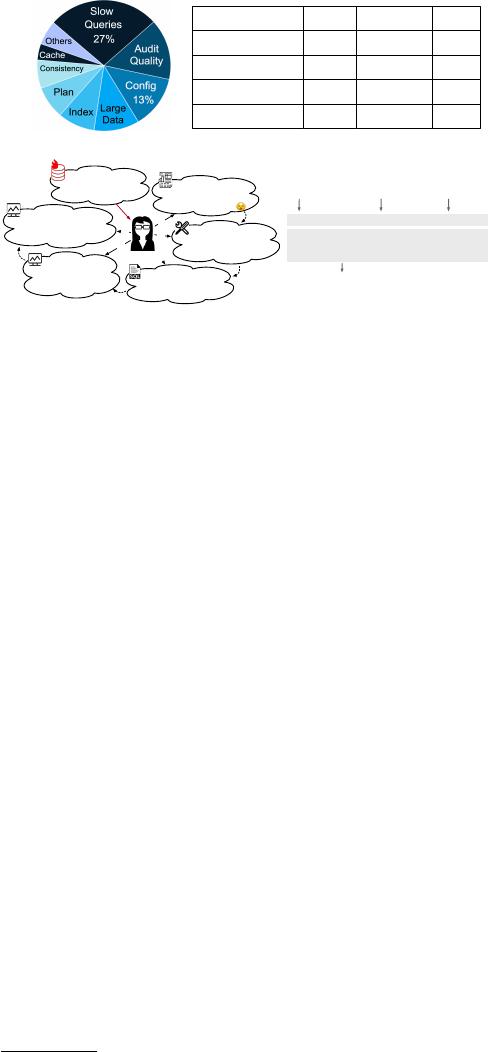
]. As shown in Figure 1 (a), a data-
base vendor encountered over 900 anomaly events in three months,
most of which spanned various facets of database and system mod-
ules (e.g., slow query processing, locking mechanisms, improper
congurations). Furthermore, these modules exhibit complex cor-
relations with system metrics (e.g., high CPU usage may result
from concurrent commits or massive calculations). So it requires to
explore dierent reasoning strategies (e.g., investigating dierent
system views) before identifying the potential root causes.
As a result, database diagnosis is a challenging problem, where
“the devil is in the details” [
11
,
62
]. Many companies rely on the
expertise of human database administrators (DBAs) to undertake
diagnosis tasks. Here we present a simplied example (Figure 1 (c)):
(1) Anomaly Notication. The database user noties an anomaly,
e.g., “routine queries
...
is 120% slower than the norm
...
”; (2) Alert
Detection. Upon receiving the user’s notication, the DBA rst
[CpuHigh alert] was
triggered, and so I need
to retrieve 5 metrics …
One query took up
60% cpu time. It may
be the bottleneck!
Ok, I cannot find
any more causes. Let’s
write the report
2.
3.
1.
4.
5.
(c) Diagnosis by Human
(a) Anomaly Events (b) Comparison of Diagnosis Methods
Routine workload
gets extremely slow …
Great! I find the query
can be optimized by
adding one index …
!
Classifier
(E.g., Decision Tree, MLP, RNN)
(d) Classifier for Fixed Scenario
Fixed Numeric Metrics
inactive_memory
process_blocked
process_running
Selected Label
(Missing Index)
Fixed
Labeles
…
High
Generalizability
Low
High
High
Low
D-Bot
Most
Low
High
Classifier
Metric-Based
Low
Most
High
Human
Efficiency
Expense
Supported Anomaly
Criteria \ Method
123
1
1469304832
Normalization
From the 5 CPU
metrics, I find some
abnormal events ..,
Figure 1: Database diagnosis is a complex problem mainly
handled by human expertise – (a) example root causes of
anomalies in a database vendor; (b) comparison of diagnosis
methods; (c) toy example of diagnosing by human DBA; (d)
example of diagnosing by machine learning classier.
investigates the triggered alerts. For instance, the DBA discovers
a “CPU High” alert, indicating the total CPU usage exceeded 90%
for 2 minutes; (3) Metric Analysis. Next the DBA delves deeper to
explore more CPU-related metrics (e.g., the number of running
or blocked processes, the number of query calls). By analyzing
these metrics, the DBA concludes the issue was caused by some
resource-intensive queries. (4) Event Analysis. The DBA retrieves
the statistics of top-k slow queries (query templates) from database
views, and nds one query consumed nearly 60% of the CPU time.
(5) Optimization Advice. The DBA tries to optimize the problematic
query (e.g., index update, SQL rewrite) by experience or tools.
The above diagnosis process is inherently iterative (e.g., if the
DBA fails to nd any abnormal queries, she may turn to investigate
I/O metrics). Besides, the DBA needs to write a diagnosis report
1
to facilitate the user’s understanding, which includes information
like root causes together with the detailed diagnosis processes.
However, there exists a signicant gap between the limited ca-
pabilities of human DBAs and the daunting diagnosis issues. Firstly,
training a human DBA demands an extensive amount of time, often
ranging from months to years, by understanding a large scale of
relevant documents (e.g., database tuning guides) and the necessity
for hands-on practice. Secondly, it is nearly impossible to employ
sucient number of human DBAs to manage a vast array of data-
base instances (e.g. millions of instances on the cloud). Thirdly, a
human DBA may not provide timely responses in urgent scenar-
ios, especially when dealing with correlated issues across multiple
1
Over 100 diagnosis reports are available on the website http://dbgpt.dbmind.cn/.

database modules, which potentially lead to signicant nancial
losses. Thus, if typical anomalies can be automatically resolved, it
will relieve the burden of human DBAs and save resources.
Driven by this motivation, many database products are equipped
with semi-automatic diagnosis tools [
20
,
22
,
29
,
30
,
32
]. However,
they have several limitations. First, they are built by empirical
rules [
11
,
62
] or small-scale ML models (e.g., classiers [
34
]), which
have poor scenario understanding capability and cannot utilize the
diagnosis knowledge. Second, they cannot be exibly generalized to
scenario changes. For empirical methods, it is tedious to manually
update and verify rules by newest versions of documents. And
learned methods (e.g., XGBoost [
8
], KNN [
17
]) require to redesign
the input metrics and labels, and retrain models for a new scenario
(Figure 1 (d)). Third, these methods have no inference ability as
human DBAs, such as recursively exploring system views based on
the initial analysis results to infer the root cause.
To this end, we aim to build an intelligent diagnosis system with
three main advantages [
65
]. (1) Precise Diagnosis. First, our sys-
tem can utilize tools to gather scenario information (e.g., query
analysis with ame graph) or derive optimization advice (e.g., index
selection), which are necessary for real-world diagnosis. However,
that is hardly supported by traditional methods. Second, it can
conduct basic logical reasoning (i.e., making diagnosis plans). (2)
Expense and Time Saving. The system can relieve human DBAs
from on-call duties to some extent (e.g., resolving typical anom-
alies that rules cannot support). (3) High Generalizability. The
system exhibits exibility in analyzing unseen anomalies based on
both the given documents (e.g., new metrics, views, logs) and past
experience.
Recent advances in Large Language Models (LLMs) oer the
potential to achieve this goal, which have demonstrated superiority
in natural language understanding and programming [
42
,
43
,
64
,
67
].
However, database diagnosis requires extensive domain-specic
skills and even the GPT-4 model cannot directly master the diagnosis
knowledge (lower than 50% accuracy). This poses three challenges.
(C1) How to enhance LLM’s understanding of the diagno-
sis problem? Despite pre-trained on extensive corpora, LLMs still
struggle in eectively diagnosing without proper prompting
2
(e.g.,
unaware of the database knowledge). The challenges include
(𝑖)
extracting useful knowledge from long documents (e.g., correla-
tions across chapters);
(𝑖𝑖)
matching with suitable knowledge by
the given context (e.g., detecting an alert of high node load);
(𝑖𝑖𝑖)
retrieving tools that are potentially useful (e.g., database catalogs).
(C2) How to improve LLM’s diagnosis performance for single-
cause anomalies? With knowledge-and-tool prompt, LLM needs
to judiciously reason about the given anomalies. First, dierent from
many LLM tasks [
12
], database diagnosis is an interactive procedure
that generally requires to analyze for many times, while LLM has
the early stop problem [
13
]. Second, LLM has a “hallucination”
problem [
46
], and it is critical to design strategies that guide LLM
to derive in-depth and reasonable analysis.
(C3) How to enhance LLM’s diagnosis capability for multi-
cause anomalies? From our observation, within time budget, a
single LLM is hard to accurately analyze for complex anomalies
2
Prompting is to add additional information into LLM input. Although LLMs can mem-
orize new knowledge with ne-tuning, it may forget previous knowledge or generate
inaccurate or mixed-up responses, which is unacceptable in database diagnosis.
(e.g., with multiple root causes and the critical metrics are in ner-
granularity). Therefore, it is vital to design an ecient diagnosis
mechanism where multiple LLMs can collaboratively tackle com-
plex database problems (e.g., with cross reviews) and improve both
the diagnosis accuracy and eciency.
To tackle above challenges, we propose D-Bot, a database diag-
nosis system using large language models. First, we extract useful
knowledge chunks from documents (summary-tree based knowl-
edge extraction) and construct a hierarchy of tools with detailed
usage instructions, based on which we initialize the prompt tem-
plate for LLM diagnosis (see Figure 3). Second, according to the
prompt template, we generate new prompt by matching with most
relevant knowledge (key metric searching) and tools (ne-tuned
SentenceBert), which LLM can utilize to acquire monitoring and
optimization results for reasonable diagnosis. Third, we introduce a
tree-based search strategy that guides the LLM to reect over past
diagnosis attempts and choose the most promising one, which sig-
nicantly improves the diagnosis performance. Lastly, for complex
anomalies (e.g., with multiple root causes), we propose a collabora-
tive diagnosis mechanism where multiple LLM experts can diagnose
in an asynchronous style (e.g., sharing analysis results, conducting
cross reviews) to resolve the given anomaly.
Contributions. We make the following contributions.
(1) We design an LLM-based database diagnosis framework to
achieve precise diagnosis (see Section 3).
(2) We propose a context-aware diagnosis prompting method that
empowers LLM to perform diagnosis by
(𝑖)
matching with relevant
knowledge extracted from documents and
(𝑖𝑖)
retrieving tools with
a ne-tuned embedding model (see Sections 4 and 5).
(3) We propose a root cause analysis method that improves the di-
agnosis performance using tree-search-based algorithm that guides
LLM to conduct multi-step analysis (see Section 6).
(4) We propose a collaborative diagnosis mechanism to improve the
diagnosis eciency, which involves multiple LLMs concurrently
analyzing issues by their domain knowledge (see Section 7).
(5) Our experimental results demonstrate that D-Bot can accurately
identify typical root causes within acceptable time (see Section 8).
2 PRELIMINARIES
2.1 Database Performance Anomalies
R1.D2
Database Performance Anomalies refer to the irregular or unex-
pected issues that prevent the database from meeting user perfor-
mance expectations [
35
,
45
], such as excessively high response time.
Figure 2 show four typical database performance anomalies
3
.
(1) Slow Query Execution. The database experiences longer re-
sponse time than expectancy. For example, the slow query causes
signicant increase in CPU usage (system load) and query duration
time, but the number of active processes remains low.
(2) Full Resource Usage. Some system resource is exhausted, pre-
venting it accepting new requests or even causing errors (e.g., insert
failures for running out of memory). For example, the high concur-
rency workload can not only cause great CPU and memory usage,
but signicantly increases the number of active processes.
3
Anomalies on the application/network sides and non-maintenance issues like database
kernel debugging and instance deployment fall outside the scope of this work.
2
of 15
免费下载
【版权声明】本文为墨天轮用户原创内容,转载时必须标注文档的来源(墨天轮),文档链接,文档作者等基本信息,否则作者和墨天轮有权追究责任。如果您发现墨天轮中有涉嫌抄袭或者侵权的内容,欢迎发送邮件至:contact@modb.pro进行举报,并提供相关证据,一经查实,墨天轮将立刻删除相关内容。
下载排行榜

评论