



ICDE2023_Automatic Fusion Network for Cold-start CVR Prediction with Explicit Multi-Level Representation_腾讯云.pdf
免费下载
Automatic Fusion Network for Cold-start CVR
Prediction with Explicit Multi-Level Representation
Jipeng Jin
∗
, Guangben Lu
†
, Sijia Li
∗
, Xiaofeng Gao
∗
,AoTan
†
, Lifeng Wang
†
∗
MoE Key Lab of Artificial Intelligence, Dept. of Computer Science and Engineering, Shanghai Jiao Tong University, China
†
Corporate Development Group, Tencent, China
{jinjipeng,qdhlsj,gaoxiaofeng}@sjtu.edu.cn, {lucasgblu,williamatan,fandywang}@tencent.com
Abstract—Estimating conversion rate (CVR) accurately has
been one of the most central problems in online advertising.
Existing methods in production focus on learning effective
interactions among features to boost the model performance.
Despite great success, these methods treat all the features equally
without distinction. However, different features suffer differently
from cold-start issues. Tail elements in those high-cardinality
features, which we denote as fine-grained features, tend to
have inadequate samples and thus fail to obtain semantically
meaningful embeddings. Interacting with those features leads
astray and impairs the accuracy of new ads in a cold-start
scenario. In this paper, we propose Automatic Fusion Network
(AutoFuse) to better tackle the challenge. AutoFuse explicitly
separates features into groups based on their granularity and
learns multiple levels of representation conditioned on different
combinations of feature groups. Concretely, AutoFuse learns an
ad-level representation to depict the unique individual character
and a group-level representation to portray the collective infor-
mation by discarding the fine-grained features. The final robust
and general ad representation is obtained by integrating these two
level representations adaptively. Such a combination encompasses
a wider amount of information, and thereby mitigates the cold-
start issue. Extensive experiments on two industrial-scale datasets
and three public datasets show that AutoFuse significantly and
consistently outperforms a spectrum of competitive methods
including our currently deployed model. Meanwhile, the remark-
able improvement on new ads validates the effectiveness of our
method in cold-start scenarios. We design AutoFuse as a generic
approach and thus it can be seamlessly transferred into other
domains. Our method has been deployed online to serve billions
of users and ads and has achieved significant GMV gain of 2.84%.
Index Terms—Cold-start, Online Advertising, CVR Prediction
I. INTRODUCTION
Accurate conversion rate (CVR) prediction is at the heart of
any real-time advertising system to achieve a win-win of both
platform and advertisers. As a conversion requires sufficient
user engagement, the training data collected from users’ feed-
back is very sparse for most advertisements (hereinafter called
ads). Such a conversion rarity problem makes the cold-start
This work was supported by the National Key R&D Program of China
[2020YFB1707903], the National Natural Science Foundation of China
[62272302, 61972254], the Shanghai Municipal Science and Technology
Major Project [2021SHZDZX0102] and the Tencent Social Ads Rhino-Bird
Focused Research Program. The authors would like to thank Wei Wang and
Yanrong Kang for their contributions in preliminary works. X. Gao is the
corresponding author.
issue in CVR prediction much more prominent. Precisely, in
a real conversion scenario, the frequency distribution of ads is
inherently long-tailed, with a few popular ads and many more
new ads. In this case, the model training may be dominated by
popular ads and leave the recommendation precision for new
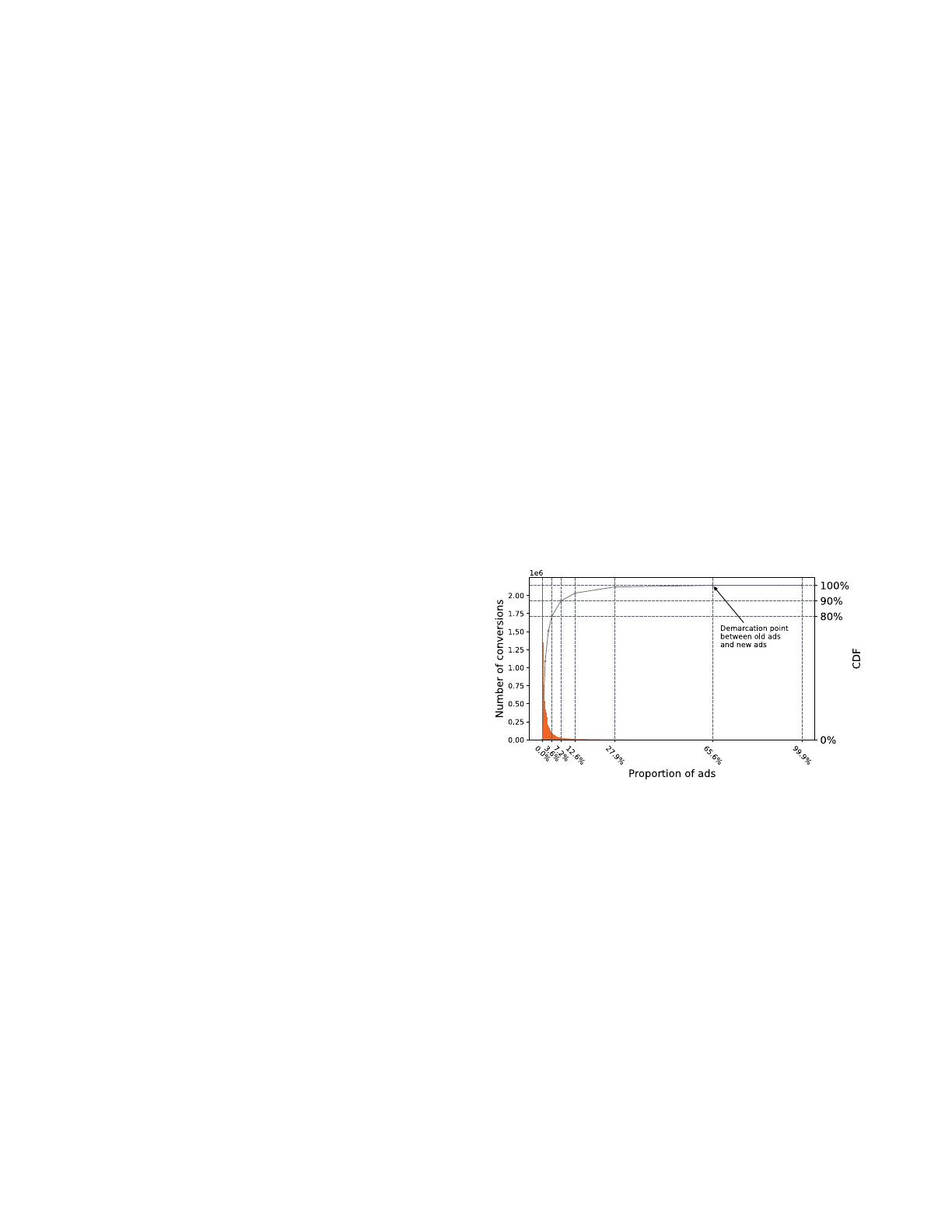
ads behind. For example, Figure 1 shows that top 7.2% of ads
occupy 90% of conversions. In practice, ads with fewer than 20
conversions within a certain time period are usually considered
as new ads. Figure 1 shows that new ads, which accounts for
34.4% of all ads, only have 0.0014% of conversions.
Fig. 1: Histogram of the number of conversions over different
proportions of ads in Tencent ad platform.
Utilizing content features of users and items is essential for
mitigating cold-start problems [1], [2]. Typically, these models
employ sophisticated neural networks to encode complicated
user states and item features in low-dimensional embedding
space and further predict each query. In practice, each feature
embedding is randomly initialized and trained repeatedly to-
wards a semantically meaningful state. However, such training
is data-demanding. Take ad identifier (ad ID) for example.
Real-world conversion data is usually highly skewed towards
popular ads. An old ad may have thousands of conversions
while a new ad barely has any. Under such a scenario, the
ID embeddings of old ads contain ample information while
a large number of new ads may overfit or fail to obtain
semantically meaningful embeddings for their associated ID.
Among hundreds of features we use, ad ID is not an exception.
The representation learning of advertiser ID and product ID
3440
2023 IEEE 39th International Conference on Data Engineering (ICDE)
2375-026X/23/$31.00 ©2023 IEEE
DOI 10.1109/ICDE55515.2023.00264
2023 IEEE 39th International Conference on Data Engineering (ICDE) | 979-8-3503-2227-9/23/$31.00 ©2023 IEEE | DOI: 10.1109/ICDE55515.2023.00264
Authorized licensed use limited to: Tencent. Downloaded on April 22,2025 at 08:35:27 UTC from IEEE Xplore. Restrictions apply.

TABLE I: The DNN model performance on Moments dataset
when removing ID features. Ad ID, campaign ID, advertiser
ID and product ID are removed one by one from V1 to V4.
V5 removes all other 9 ID features.
Model New Ads Old Ads Overall
DNN 0.8175 0.8449 0.8436
V1 0.8206 0.8386 0.8375
V2 0.8233 0.8354 0.8332
V3 0.8267 0.8326 0.8322
V4 0.8269 0.8323 0.8315
V5 0.8293 0.8304 0.8299
TABLE II: The DNN model performance on KDD2012 Cup
dataset when removing ID features. Ad ID, description ID and
advertiser ID are removed one by one from V1 to V3. Removal
of more ID features causes severe performance decrease in all
situations.
Model New Ads Old Ads Overall
DNN 0.6924 0.7503 0.7414
V1 0.6942 0.7458 0.7372
V2 0.6941 0.7436 0.7350
V3 0.6963 0.7407 0.7327
is also challenging since there exist large amounts of small
advertisers and niche products with a narrow appeal.
Table I shows the performance of base model (DNN [3],
currently used in Tencent platform) when features mentioned
above are gradually removed. We can observe that the perfor-
mance increases on new ads but decreases severely on old ads,
hence the overall performance is deteriorated. Similar results
can be reproduced in public dataset as shown in Table II. It
demonstrates the duality of these features: beneficial for the
old ads while ineffectual for new ones. However, the distribu-
tion of some features are moderate, e.g., product and industrial
category. Those features tend to have small cardinality and the
training samples for tail elements are sufficient enough. We
denote the former type of feature as fine-grained feature and
the latter type as coarse-grained feature. From this perspective,
the cold-start issue can be characterized as the inability to
provide effective embeddings for fine-grained features, thereby
impairing the final condensed ad representation.
Existing methods in CVR prediction employ similar tech-
niques developed in click-through rate (CTR) prediction [4]–
[6]. These methods aim to learn effective low- and high-order
feature interactions and thus significantly improve the perfor-
mance. However, these methods treat all the features equally
without distinction. As mentioned above, new ads tend to have
unreasonable embeddings for fine-grained features. Interacting
with such features may not yield expected effectiveness, and
further impairs the performance for new ads. Thus, special
attention should be attached to the feature grouping in cold-
start scenarios.
Intuitively, as shown in Figure 2(a), disregarding the dif-
ference between feature types and utilizing a single model
on all ads may not work well on new ads, despite its good
performance on old ads. On the other hand, discarding the
fine-grained features directly in Figure 2(b) can increase
the performance on new ads significantly, but sacrifices the
accuracy on old ads as fine-grained features contain unique
character and is indispensable. Figure 2(c) combines the
two models mentioned above and builds separate models for
different ads, use Figure 2(a) to predict CVR for old ads and
Figure 2(b) for new ads. It performs much worse since new
ads have much fewer data and much more intrinsic noise,
which make the complicated models hard to learn. Moreover,
decoupling suffers from different model update effectiveness,
which results in a large precision gap between old and new
ads. Meanwhile, maintaining multiple models simultaneously
consumes huge amounts of both computation and storage
resources, as well as required human effort. Hence, it is desired
to design a more powerful and efficient model.
In a real production scenario, new ads tend not to be
loners, but instead implicitly exist in smaller groups and larger
clusters. An advertiser may share same creative features among
its ads in one campaign. Ads within same category always have
overlapping features and collective commonalities. Moreover,
statistic shows that duplication of ads exists universally in our
platform. These are just few examples and the intrinsic con-
nection between ads is far more complicated than we thought.
Traditional models view an ad as an isolated individual and
ignore the potential of collective patterns. Though ad-specific
representations contain ample information for old ads, we
argue that those new ads are encouraged to facilitate collective
patterns to obtain more robust and general representations.
Since different new ads share some identical feature values,
these values divide new ads into groups naturally. The model
can extract informative group-level representations for new
ads with few conversions. In this way, cold-start issue can
be effectively alleviated.
To this end, we propose Automatic Fusion Network (Aut-
oFuse) to simultaneously learn multiple levels of represen-
tation with different feature groups. We illustrate simplified
architecture of AutoFuse in Figure 2(d). For each ad, we
first learn an ad-level representation with all the features to
depict the unique individual character. Then, we discard fine-
grained features and only utilize coarse-grained features to
learn group-level representation to portray the collective in-
formation in a broad and abstract perspective. Finally, through
dynamic fusion, we integrate these two level representations
to obtain a robust and general representation for this ad. The
dynamic fusion module can combine ad-level and group-level
representations selectively according to the popularity feature
of each ad, thereby producing a synergy effect between ad-
and group-level learning.
To evaluate our proposed method, we conduct extensive ex-
periments on public datasets and real-world industrial conver-
sion datasets sampled from Tencent ad platform. Experimental
results demonstrate that AutoFuse consistently outperforms
state-of-the-art baseline methods across all datasets, showing
significant improvement on not only old ads, but also new ads
especially.
The main contributions of this work are summarized as
follows:
3441
Authorized licensed use limited to: Tencent. Downloaded on April 22,2025 at 08:35:27 UTC from IEEE Xplore. Restrictions apply.
of 13
免费下载
【版权声明】本文为墨天轮用户原创内容,转载时必须标注文档的来源(墨天轮),文档链接,文档作者等基本信息,否则作者和墨天轮有权追究责任。如果您发现墨天轮中有涉嫌抄袭或者侵权的内容,欢迎发送邮件至:contact@modb.pro进行举报,并提供相关证据,一经查实,墨天轮将立刻删除相关内容。
下载排行榜

评论