



Distributed Architecture of Oracle Database In-memory.pdf
免费下载

1
Distributed Architecture of Oracle Database In-memory
Niloy Mukherjee, Shasank Chavan, Maria Colgan, Dinesh Das, Mike Gleeson, Sanket Hase,
Allison Holloway, Hui Jin, Jesse Kamp, Kartik Kulkarni, Tirthankar Lahiri, Juan Loaiza, Neil
Macnaughton, Vineet Marwah, Atrayee Mullick, Andy Witkowski, Jiaqi Yan, Mohamed Zait
Oracle Corporation
500 Oracle Parkway, Redwood Shores, CA 94065
{Niloy.Mukherjee}@Oracle.com
ABSTRACT
Over the last few years, the information technology industry has
witnessed revolutions in multiple dimensions. Increasing
ubiquitous sources of data have posed two connected challenges
to data management solutions – processing unprecedented
volumes of data, and providing ad-hoc real-time analysis in
mainstream production data stores without compromising regular
transactional workload performance. In parallel, computer
hardware systems are scaling out elastically, scaling up in the
number of processors and cores, and increasing main memory
capacity extensively. The data processing challenges combined
with the rapid advancement of hardware systems has necessitated
the evolution of a new breed of main-memory databases
optimized for mixed OLTAP environments and designed to scale.
The Oracle RDBMS In-memory Option (DBIM) is an industry-
first distributed dual format architecture that allows a database
object to be stored in columnar format in main memory highly
optimized to break performance barriers in analytic query
workloads, simultaneously maintaining transactional consistency
with the corresponding OLTP optimized row-major format
persisted in storage and accessed through database buffer cache.
In this paper, we present the distributed, highly-available, and
fault-tolerant architecture of the Oracle DBIM that enables the
RDBMS to transparently scale out in a database cluster, both in
terms of memory capacity and query processing throughput. We
believe that the architecture is unique among all mainstream in-
memory databases. It allows complete application-transparent,
extremely scalable and automated distribution of Oracle RDBMS
objects in-memory across a cluster, as well as across multiple
NUMA nodes within a single server. It seamlessly provides
distribution awareness to the Oracle SQL execution framework
through affinitized fault-tolerant parallel execution within and
across servers without explicit optimizer plan changes or query
rewrites.
1. ORACLE DBIM – AN OVERVIEW
The area of data analytics witnessed a revolution in the past
decade with the deluge of data ingestion sources [1]. The past
decade therefore witnessed a resurgence of columnar DBMS
systems, e.g., C-Store [2] and Monet DB [3], as pure columnar
format became a proven standard suited for traditional data
warehousing and analytics practice where the historical data is
first curated in usually dedicated data warehouses, separate from
the transactional data stores used in mainstream production
environment. However, being unsuitable for OLTP workloads,
pure columnar format is not entirely ideal for the real-time
analytics use-case model that demands high performance analysis
of transactional data on the mainstream production data stores. In
comparison, traditional industry-strength row-major DBMS
systems [4] have been well suited for OLTP workloads but have
incurred manageability and complexity overheads required in
computation and maintenance of analytic indexes and OLAP
engines geared towards high performance analytics [4].
Even though Oracle TimesTen [5] was one of the first industry-
strength main-memory databases developed in mid 1990s, it is
only over the last few years that the explosion in processing and
memory capacity in commodity systems has resulted in the
resurgence of main memory based database systems. These
include columnar technologies such as SAP HANA [6], IBM
BLU [7] etc. as well as row-oriented ones such as Oracle
TimesTen and H-Store [8]. As DRAM capacity keeps on
increasing and becoming cheaper [9], main memory no longer
remains a limited resource. Today’s multi core, multiprocessor
servers provide fast communication between processor cores via
main memory, taking full advantages of main memory
bandwidths. Main memory is therefore being conceived by DBMS
architects more as a primary storage container and less as a cache
optimizing disk based accesses.
With this precursor, we present a quick overview of Oracle
Database In-memory Option (DBIM) [10] [11] that was
introduced in 2014 as the industry-first dual format main-memory
database architected to provide breakthrough performance for
analytic workloads in pure OLAP as well as mixed OLTAP
This work is licensed under the Creative Commons Attribution-
NonCommercial-NoDerivs 3.0 Unported License. To view a copy of this
license, visit http://creativecommons.org/licenses/by-nc-nd/3.0/. Obtain
permission prior to any use beyond those covered by the license. Contact
copyright holder by emailing info@vldb.org. Articles from this volume were
invited to present their results at the 41st International Conference on Very
Large Data Bases, August 31st – September 4th 2015, Kohala Coast, Hawaii.
Proceedings of the VLDB Endowment, Vol. 8, No. 12
Copyright 2015 VLDB Endowment 2150-8097/15/08.
1630
2
environments, without compromising or even improving OLTP
performance by alleviating the constraints in creating and
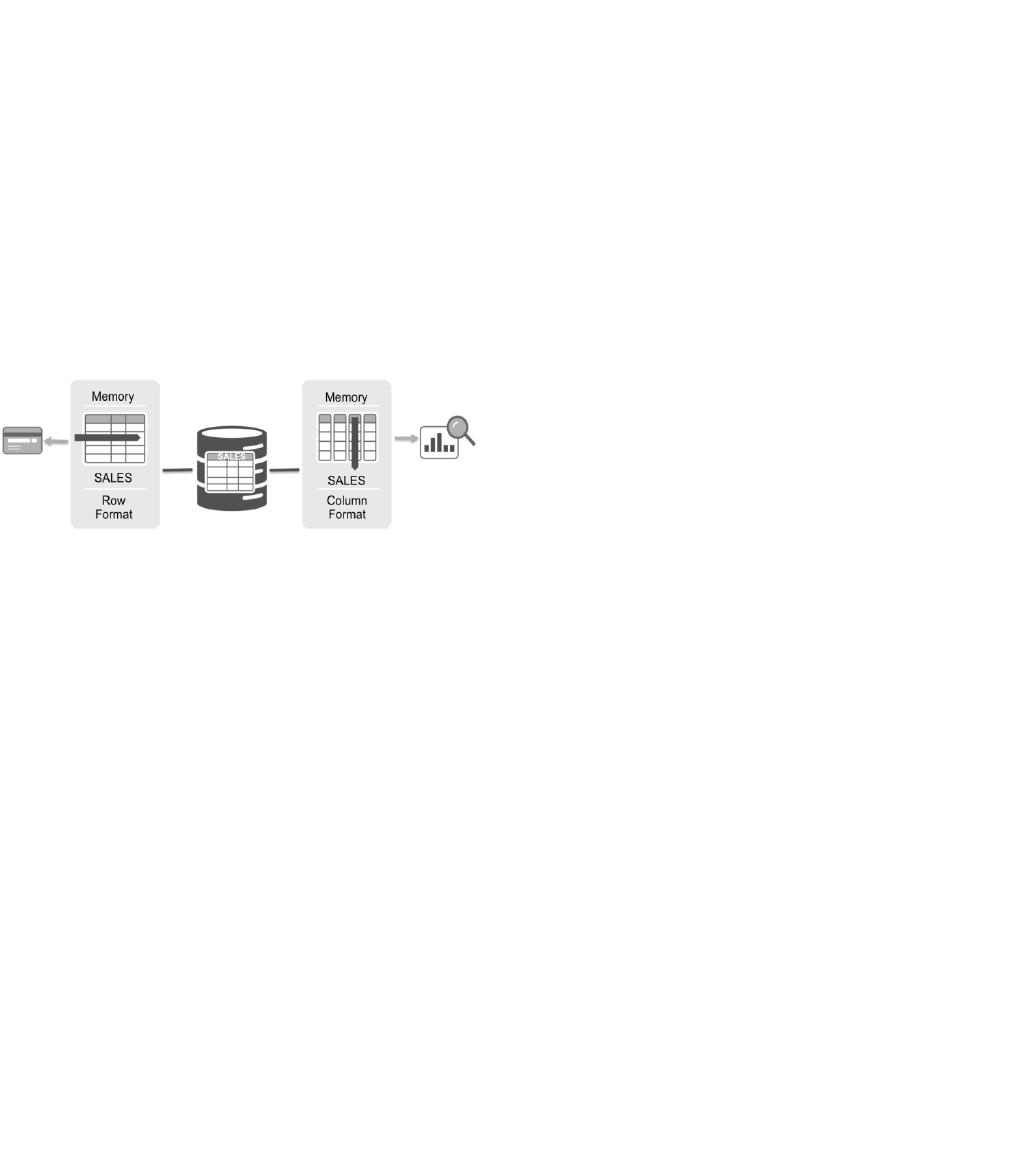
maintaining analytic indexes [11]. The dual-format in-memory
representation (Figure 1) allows an Oracle RDBMS object (table,
table partition, table subpartition) to be simultaneously
maintained in traditional row format logged and persisted in
underlying storage, as well as in column format maintained purely
in-memory without additional logging. The row format is
maintained as a set of on-disk pages or blocks that are accessed
through an in-memory buffer cache [12], while the columnarized
format is maintained as a set of compressed in-memory granules
called in-memory compression units or IMCUs [10][11] in an In-
memory Column Store [11] transactionally consistent with the
row format [13]. By building the column store into the existing
row format based database engine, it is ensured that all of the rich
set of Oracle Database features [4][11] such as database recovery,
disaster recovery, backup, replication, storage mirroring, and node
clustering work transparently with the IM column store enabled,
without any change in mid-tier and application layers.
Figure 1. Dual-format representation of Oracle DBIM.
The dual format representation is highly optimized for maximal
utilization of main memory capacity. The Oracle Database buffer
cache used to access the row format has been optimized over
decades to achieve extremely high hit-rates even with a very small
size compared to the database size. As the In-memory Column
Store replaces analytic indexes, the buffer cache gets better
utilized by actual row-organized data pages. Besides providing
query performance optimized compression schemes, Oracle
DBIM also allows the columnar format to be compressed using
techniques suited for higher capacity utilization [11].
Unlike a pure in-memory database, the dual format DBIM does
not require the entire database to have to fit in the in-memory
column store to become operational. While the row format is
maintained for all database objects, the user is allowed to specify
whether an individual object (Oracle RDBMS table, partition or
subpartition) should be simultaneously maintained in the in-
memory columnar format. At an object level, Oracle DBIM also
allows users to specify a subset of its columns to be maintained
in-memory. This allows for the highest levels of capacity
utilization of the database through data storage tiering across
main-memory, flash cache, solid state drives, high capacity disk
drives, etc.
A detailed description of Oracle DBIM features is available at the
Proceedings of the 31
st
International Conference on Data
Engineering 2015 [11]. In this paper, we primarily aim to
concentrate on various aspects of the distributed architecture of
Oracle DBIM, its underlying components, and related methods
behind its transparency and seamlessness.
2. NEED FOR A DISTRIBUTED
ARCHITECTURE
As enterprises are witnessing exponential growth in data ingestion
volumes, a conventional wisdom has developed across the
industry that scaling out using a cluster of commodity servers is
better suited for executing analytic workloads over large data sets
[13]. There are several valid reasons for development of such a
perception. Scale-out enables aggregation of computational
resources of multiple machines into a virtual single machine with
the combined power of all its component machines allowing for
easier elastic expansion [14]. Furthermore, since each node
handles only a part of the entire data set, there may not be the
same contention for CPU and memory resources as characterized
by a centralized DBMS [15]. The scenario is particularly relevant
for main-memory based RDBMSs. With increasing deluge of data
volumes, the main memory of a single machine may not stay
sufficient.
However, in the last couple of years or so, several researchers and
industry experts have raised the question whether it is time to
reconsider scale-up versus scale-out [16]. They provide evidence
that the majority of analytics workloads do not process huge data
sets at a given time. For example, analytics production clusters at
Microsoft and Yahoo have median job input sizes less than 14 GB
[17], and 90% of jobs on a Facebook cluster have input sizes
under 100 GB [17]. Moreover, hardware price trends are
beginning to change performance points. Today’s commodity
servers can affordably hold 100s of GB of DRAM and 32 cores on
a quad socket motherboard with multiple high-bandwidth memory
channels per socket, while high end servers such as the M6
Oracle Sun SuperCluster [18] providing up to 32 TB of DRAM
and 1024 cores, are also becoming more commonplace.
As far as implementation of scale-up parallelism in main-memory
architectures is concerned, it may seem less complex because the
memory address space is completely shared in a single server.
However, current state-of-the-art multi processor systems employ
Non-uniform Memory Access or NUMA [19], a memory design
where the memory access time depends on the memory location
relative to the processor. Accesses from a single processor to
local memory provides lower latency compared to remote memory
accesses as well as alleviates interconnect contention bottlenecks
across remote memory controllers. As a result, a NUMA-based
distributed in-memory framework becomes necessary even in a
single SMP server and gets extremely relevant for larger SMPs
like the SuperCluster.
Even if a monolithic server meets the capacity/performance
requirements of a data processing system, scale-out architectures
can be designed to offer visible benefits of high availability and
minimal recovery; features that are most relevant for a non-
persistent volatile main-memory database [10]. A single main-
memory database server poses the risk of a single point of failure.
In addition, the recovery process (process to re-populate all data
in memory) gets relatively long, leading to extended downtime. A
distributed main-memory system can be designed to be fault
tolerant through replication of in-memory data so that it exists at
more than one site. It also provides the scope to design extremely
efficient redistribution mechanisms for fast recovery.
1631
of 12
免费下载
【版权声明】本文为墨天轮用户原创内容,转载时必须标注文档的来源(墨天轮),文档链接,文档作者等基本信息,否则作者和墨天轮有权追究责任。如果您发现墨天轮中有涉嫌抄袭或者侵权的内容,欢迎发送邮件至:contact@modb.pro进行举报,并提供相关证据,一经查实,墨天轮将立刻删除相关内容。
下载排行榜

评论